Gadolinium & other toxins damage your mitochondria and metabolism
Have you ever felt like you have a sluggish metabolism?
Or maybe I should have asked “when’s the last time you complained about having a sluggish metabolism?”
Feel like your get up and go got up and left? You might have a broken metabolism because you’re suffering from mitochondrial damage.
5 little secrets your doctor probably doesn’t know about mitochondria
Three cheers for our awesome mitochondria! Without them we literally wouldn’t be where or who we are.
Did you know that your cells contain tiny power generators called mitochondria? It’s these tiny power generators that literally power practically everything you do. And not just the active stuff. They also power you when you’re resting and sleeping. They keep you breathing, keep your heart beating, help you digest and dream and feel and move.
Your doctors have studied mitochondria in medical school. But sometimes it’s hard for them to translate those lessons into real world applications, because a lot of the focus was on the reactions that happen inside mitochondria. In fact, truth be told, some of your doctors wondered what the point was in learning all that biochemistry in so much depth. It’s not like it was ever going to come in handy when treating actual patients.
Question for the doctors: were you relieved to pass those science exams so that you could immediately forget them and move on to the important stuff, like identifying and treating diseases with the right drugs and surgeries?
You’re probably wondering why it’s important for you to learn anything about mitochondria
What if I told you that both your health and how long you’ll live are determined by how healthy your mitochondria are?
And what if I told you that there are lots of small and large decisions that you’re making every single day that can alter the state of play for your mitochondria in both positive and negative ways.
Have mitochondria suddenly started to sound a bit more interesting? They hold some to the secrets to life and death. Unfortunately, they’re also vulnerable and prone to malfunction. Malfunction or dysfunction of your mitochondria tends to become more common as we age.
But a steady, or rapidly accelerating, deterioration in health isn’t inevitable.
There are lots of different things that can impact your mitochondrial health and performance. Which also means that there’s loads that you can do to improve them, too.
Your metabolism is ruled by your mitochondria
This article reveals 5 secrets that can help you to unlock some of the mysteries of mitochondria and how you can begin to harness them to improve your health.
Without mitochondria there are only single celled microbes: bacteria and archaea.
So why on earth do we keep damaging them? It’s like a mass suicide pact that we all have. How have we prioritised convenience and the pursuit of money over our own health?
Because we didn’t realise how precious and vulnerable our mitochondria are to damage? Most of us are completely unaware of their importance, or the precariousness of their health, until it’s too late.
Despite the fact that metabolic syndrome and related disorders are the commonest causes of chronic illness, not many people realise that it’s because their mitcohondria have been damaged
And by “most of us” I’m including doctors. Your doctor is pretty unlikely to pick up on the fact that your symptoms of a broken metabolism are due to mitochondrial damage.
That’s because they’ve been taught that the only thing that can go wrong with mitochondria is gene mutations in one of the 13 mitochondrial genes that still reside in the mitochondria themselves. Generally, doctors aren’t even aware that nearly all of the genes that mitochondria need to function have long ago been packaged up, shipped out and relocated in our nuclear DNA, with the rest of our genetic material.
And doctors aren’t generally aware that environmental toxins, poor nutrition and lifestyle choices can harm your mitochondria.
But I’m getting ahead of myself. What are mitochondria?
Mitochondria are fascinating. We often call them the powerhouses of the cells, or cellular batteries because they’re responsible for producing almost all the energy that keeps us alive and functioning.
Think of your mitochondria as your primary power generators. They’re small, yet mighty.
The reason you need to eat and breathe is so that you can provide your cells with combustable fuel and oxygen. In addition, you need to consume all the raw materials necessary for you to create and repair your tissues and the machinery you need to perform every function in your body. Breathing is also how you get rid of carbon dioxide, the main waste product made by your mitochondria when they burn your food to make energy.
All of that combustion generates a lot of heat.

Did you know that the temperature inside mitochondria runs a lot hotter than body temperature? The temperature inside your mitochondria actually approaches 50℃!
Here’s some new research showing that mitochondria can fire up short bursts of heat lasting as short as a second, and increasing the temperature even further. These brief flashes of heat can boost internal mitochondrial temperatures in under a second by as much as 5℃. Isn’t that phenomenal? It’s almost like a mini explosion. Or a bolt of lightning. In fact, research suggests that the electric field strength across the mitochondrial membranes may be as much as 30 million volts per metre. That’s the equivalent of a bolt of lightning!

It seems like this extra heat energy comes from stored protons.
“Mitochondria Health is so closely intertwined with our health that you could say mitochondrial health = our health. And mitochondrial disease = our disease.”

You can’t expect to have damaged mitochondria and feel great.
Secret #1. Mitochondrial damage is at the heart of every major modern chronic disease, as well as the ageing process.

In fact mitochondrial damage has now been linked with every major chronic disease. When you go looking for it in illness, you’ll find mitochondrial damage and dysfunction. This is true of:
In fact I’ve previously written a post on the increased risk that young people with congenital heart disease have of being diagnosed with cancer here. I mentioned mitochondrial dysfunction in it, but didn’t go into a lot of detail.
Secret #2. Our world is full of dangerous toxins and other things that can cause a broken metabolism, damage your mitochondria and steal your health
What’s concerning, and something that a lot of people aren’t aware of, is that every single day we’re exposed to things that are toxic to our mitochondria and cause them damage. Some of that damage might be reversible when you remove the toxin. But some of it isn’t. And some toxins are a lot harder to get rid of than others.
Like the persistent organic pollutants, DDT, PCBs and dioxins.
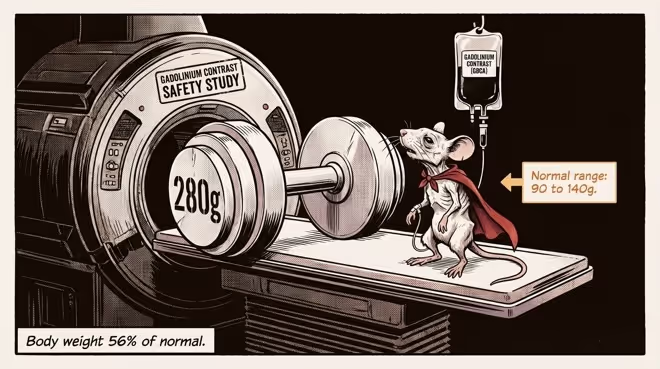
Or like gadolinium and other heavy metals, such as mercury or lead. You’re probably aware that I’m only one of an increasing group of people who’ve experienced severe gadolinium side effects like these. If you’d like to read more about my journey with gadolinium toxicity, I’ve written about it more here and here.
While efforts are being made to reduce environmental exposures to mercury and lead, the opposite is true of gadolinium. Gadolinium pollution is occurring primarily as a result of the increasing use of gadolinium based contrast agents for MRIs. We’re using gadolinium based contrast so frequently that river and coastal waters are becoming polluted with gadolinium. Many aquatic species that have been studied have displayed evidence of gadolinium side effects.
Certainly, this could be calamitous for aquatic environments. But it also means that gadolinium is entering both our food and water supplies. So many of us are going to be unknowingly exposed to more of this toxin in our diets. Gadolinium compounds now appear to be the most ubiquitous water contaminant in most countries with advanced healthcare systems, including England, the USA, Japan, Germany, France and Australia. Gadolinium is now classified as one of the Microcontaminants of Emerging Concern (MECs). Gadolinium based contrast agents are a new type of persistent organic pollutant (POP).
Gadolinium compounds are used in many industries, but healthcare is probably responsible for most of our exposure.
| Where it’s used | What it’s used for |
|---|---|
| Medicine | MRI contrast agents (the “dye” injected for some scans), used to show blood vessels, the heart, bones and joints, cancers, inflammation and the brain |
| Electronics | Magnets in electronics and wind turbines, microwave ovens, high-power lasers, optical fibres, data storage, and old-style TV and computer screens |
| Energy | Control rods in nuclear reactors, because it soaks up neutrons, and detecting radiation leaks |
| Aircraft and ships | Special imaging screens that help find hidden cracks in plane bodies and ship hulls |
| Cars | Small amounts in catalytic converters, which clean up exhaust fumes |
| Metalwork | Added to iron and chromium alloys to make them easier to work and better at resisting heat and rust |
| Glass | Making and polishing glass, including lenses |
Adapted from Ebrahimi and Barbieri, Gadolinium as an emerging microcontaminant in water resources, Geosciences 2019 (CC BY 4.0).
When persistent toxins are retained in your body, they continually damage your mitochondria. And by extension, almost all cellular processes. Remember that almost every process that needs energy to drive it (which is almost every single important thing that goes on inside your body) relies on mitochondria.
Don’t believe me? It’s mitochondria that utilise almost all of the oxygen you require when you breathe. And they do it to produce energy. How long can you survive without oxygen? A few minutes. In those few minutes it’s your mitochondria that are all cataclysmically failing together. If that’s not reversed quickly, you die.
Have you ever heard of cyanide poisoning? Cyanide is another very well known mitochondrial toxin. A big enough dose kills in minutes.
Why don’t all of these other mitochondrial toxins kill us within minutes? Well, the dose makes the poison.
Your mitochondria can be exposed in a patchy fashion with smaller doses. Some will mop up more toxins and others less.

Here are some other toxic exposures that can impact your mitochondria:
Contaminants in your water supply
Medication side effects, but also impurities found in generic and brand medications (you really should check out Katherine Eban’s work on this. She’s written a book called Bottle of Lies as well as a lot of articles on the subject. But also check out this article all about the pharmaceutical cabal)
Work exposures
Home environment (think about chemicals that you use in your garden, your cleaning products, skincare, deodorants, toothpastes, makeup, air fresheners, flame retardants, and more)
EMF exposures (EMF has been shown to alter how channels, called voltage gated calcium channels, work and to cause increased free radical production and a reduction in our master antioxidant, glutathione)
Exposure to blue light in the evenings (via screens TV, smartphones, computers and even bright white LED bulbs can interfere with your normal sleep cycle)
Dental practices (amalgam fillings, dental implants and root canals for starters)
Surgical implants (everything from breast implants to titanium hips)
And while all of your cells contain mitochondria (with the exception of mature red blood cells, which have jettisoned theirs), different cells contain different numbers of them.
Some cells may contain thousands of mitochondria, like heart, liver, kidney and brain cells. Other cell types might only contain a few mitochondria, like white blood cells. The busier the cells and the more they need to do, the greater the amount of energy they need to generate and the more mitochondria they need to have to meet those requirements.
What are some common symptoms of mitochondrial dysfunction?
Mitochondria can limp along with milder degrees of damage, but you might start experiencing symptoms like:
fatigue,
brain fog,
anxiety,
depression,
weight gain,
temperature regulation problems,
blood sugar problems,
high blood pressure,
pains,
weakness,
gut problems,
irritable bowel,
chronic inflammation,
numbness,
seizures,
anaemia,
muscle twitches,
palpitations…
The list goes on and on.
As you can see, predicting symptoms from mitochondrial toxicity becomes very difficult. The mitochondria that end up being exposed to the highest levels of toxins will be hit the hardest. But what determines how you’ll manifest mitochondrial toxicity is a mixture of:
pot luck,
illnesses that can alter your blood flow to different organs,
infectious diseases,
the dose of the toxin you receive,
what other toxins you’ve been exposed to over the course of your life,
your overall state of health and nutrition,
your genetics and many other factors.
Secret #3. Your mitochondria do a great deal more than make energy. Which is exactly why the symptoms of mitochondrial dysfunction are so pedestrian, and so easy for everyone to write off as something else.
Let's talk about what mitochondrial dysfunction actually feels like.
Tired. Foggy. Achy. Queasy after certain meals. Wired at midnight and snoring at your desk at three in the afternoon. Cold hands. A heart that races going up the stairs. Twitchy. Anxious. Intolerant of exercise, of alcohol, of heat, or of all three.
Not one of those is dramatic. Not one of them shows up on a standard blood panel. And every single one has a tidier explanation waiting in the wings: you're stressed, you're run down, you're getting older, you're doing too much, you're a bit anxious.
I'm not going to pretend stress isn't involved. It nearly always is, and we'll come back to why in a bit.
But there's a reason the symptom list reads like a laundry list, and it isn't that the symptoms are vague. Our all-too-brief education on mitochondria skipped some of the best bits, so let me explain them now.
You were taught they're the powerhouse of the cell.
I sat in that lecture too. I drew the little bean with the squiggly line inside it, wrote "powerhouse of the cell" underneath, and kept scribbling maniacally (an extra secret is that doctors' handwriting is born in lectures where you can't keep up with the rate of regurgitation of facts and figures). Because apparently that was all a doctor needed to know.
Calling a mitochondrion a powerhouse is like calling a hospital a building with beds in it. Technically true. Wildly incomplete.
Here's some of what else is going on inside those magic beans.
They make your steroid hormones.
The very first step in converting cholesterol into a hormone occurs on the inner mitochondrial membrane, courtesy of an enzyme called CYP11A1. It's the rate-limiting step of the whole kit and caboodle. Cortisol starts there. So do your sex hormones. Park that thought.
They start disposing of ammonia (yeah... another toxin, and one you make yourself).
The first two steps of the urea cycle happen inside the mitochondrial matrix and cluster at the inner mitochondrial membrane.
They build your haem.
Not just the red pigment in your blood and muscles. Haem is the active part of a great many other enzymes too, including many that detoxify you. There's a surprise bonus secret at the end all about it.
Oh, I guess now it's not a surprise any more.
They decide when a cell should die.
Programmed cell death runs through the mitochondrion. Which means the machinery stopping a damaged cell from ploughing on regardless and turning into an uncontrollable mass of dividing cells is the same machinery a toxin has just been interfering with. Worth pondering for a second, given what Secret #1 said about cancer.
They handle a great deal of your amino acid metabolism,
Including the branched-chain amino acids, glutamine, glycine, and a large slice of the folate one-carbon pathway that everyone discusses in terms of methylation.
They buffer your calcium, build your iron-sulphur clusters, make your ketones, and generate heat.
And then there's the one I want to spend longer on.
They are the custodians of stress neurotransmitters and some other amines.
There's an enzyme sitting on the outer mitochondrial membrane called monoamine oxidase. MAO, for short. If you've heard of it at all, it'll be because of antidepressant MAO inhibitors or the "warrior gene".
MAO breaks down serotonin, dopamine, noradrenaline and adrenaline. That's the version you get in the psychiatry lecture, and it's why the enzyme is infamous.
But this is just a fraction of its job.
MAO also handles tyramine, tryptamine, phenylethylamine, octopamine and benzylamine. And once another enzyme has had first go at histamine, it's MAO-B that takes the next step.
So, where do those amines come from? Aged cheese. Cured and fermented meats. Soy sauce, miso, sauerkraut, kimchi. Red wine and draught beer. Yeast extract. Chocolate and coffee. Dried fruits. Anything that's been sitting around getting more interesting, addictive and particularly delicious, and anything your gut bacteria have been busy with.
Which is to say: a great deal of what modern nutrition advice is currently telling you to eat more of, for the sake of your microbiome.
Now, medicine knows perfectly well that this matters. It matters so much that if you're prescribed an MAO inhibitor, you get handed a printed list of foods to avoid because they could give you a hypertensive crisis while on the drug. Aged cheddar and Stilton sit near the top of it. The numbers are stark: most people can handle several hundred milligrams of tyramine without their blood pressure so much as twitching, while somebody on an irreversible MAO inhibitor can have a reaction at six.
Somebody sat down and laboriously typed that list out in the halcyon days before word processors, because the consequences of ignoring it can put you in the hospital.
But you only get the list if you're on the drug.
If your own MAO capacity is under pressure for any other reason, nobody hands you anything at all. You just feel dreadful after dinner and get told to eat more fermented foods.
And here's the bow that ties it together. When MAO does its job, it produces hydrogen peroxide, an aldehyde, and ammonia. All three are toxic. And all three disposal routes are mitochondrial, or start there: peroxiredoxin 3 handles about 90% of the hydrogen peroxide in the mitochondrial matrix, ALDH2 handles the aldehyde, and the urea cycle handles the ammonia.
So the organelle that generates the mess is the organelle that clears it up. Damage your mitochondria, and you don't get one problem. You get the mess and the failure to clean it, landing simultaneously.
If you're one of the people living with mast cell activation, this is where it gets personal.
Mast cells sit in your connective tissue, and when they detect trouble, they release over two hundred mediators. Histamine is the one everybody's heard of. In my ATTRACT framework, which describes what I believe explains most of modern chronic illness (you can learn more about it here), those cells aren't malfunctioning at all. They're the conductors, responding entirely logically to a body that's under siege.
Now, let's put the two halves together.
Histamine gets methylated first, and then it's MAO-B, out there on the mitochondrial membrane, that carries out the next step. So if your mitochondria are struggling, the tap is running harder, and the drain is narrower. At the same time.
That's my theory anyway, and it's a good one, but it's not an uncontested fact. However, it would explain a great deal about why so many of us end up with mast cell problems, food intolerances and exhaustion, while our doctors are flummoxed as to why they all seem to appear simultaneously.
Which brings us back to stress.
Your cortisol starts in a mitochondrion. Your serotonin, dopamine, noradrenaline, and their toxic byproducts are cleared by enzymes bound to or inside your mitochondria. So when a doctor looks at you and says "I think this is stress", and you look back and say "something is wrong with my body", it's entirely possible you're both describing the same broken machinery from opposite sides.
They aren't wrong that the stress axis is involved. They're just assuming they already know which way the arrow points when all along it's a circle.
That's why mitochondrial trouble turns up as fifteen unremarkable complaints instead of one bizarre one. You haven't broken a system. You've degraded a component that hundreds of systems are quietly leaning on.
And a person with fifteen unremarkable complaints, whose bloods are all normal, gets a psychological label.
Every time.

Secret #4. Decisions that you make now can affect the health of your offspring and their children. Likewise, some of your health challenges might actually be to do with something that your parents or grandparents did.
We are even discovering that things that your parents and even grandparents were exposed to can alter YOUR health because genes being switched on and off can be transmitted down through generations. This is called transgenerational epigenetic inheritance. I blame it for my extreme dislike of very large spiders.
Transgenerational epigenetic inheritance is exemplified by the agouti mouse experiments, where more wholesome parental diets and nutrient supplements in the parent mice can alter the appearances of the offspring from plump and blonde to slim and brown. You can watch an explanation of agouti mouse experiments here.
Secret #5. There are loads of ways that you can actually support and help to repair your mitochondria, even after they’re damaged and even if you’re stuck with persistent toxins that are hard to eliminate.

How do you support and repair your mitochondria? There’s no magic bullet. Sometimes, if you can identify the toxin and remove it, that will be enough. But it’s seldom just a single toxin. And sometimes the toxins aren’t so easy to remove, particularly when they’re retained in your body.
So what else can you do to support your mitochondria? Change almost everything. From your diet to your sleep patterns, from the right exercise to reducing stress, from getting outside into the sun and nature to forming close connections with other people. Not to mention targeted mitochondrial supplements, like PQQ, CoQ10, and D-ribose.
There is so much that you can do using diet that you could write a book about it. But you definitely want to:
do your utmost to avoid malnutrition,
identify foods that can be more inflammatory and minimise or remove them completely, and
focus on including foods that can boost your own antioxidant production inside your cells.
For a nourishing recipe that harnesses some of these foods, check out this trottery goodness bone broth recipe. Some of your nutritional requirements may need to be personalised, eg if you’ve been diagnosed with any autoimmune conditions chances are you’ll have multiple food intolerances that you’ll need to identify.
You might also believe that you probably don’t have malnutrition because you try to follow national dietary guidelines. However, as people tend to adhere more and more closely to government guidelines we become more and more malnourished. I’ve written about this paradox here. But I’ve got news for you: it’s not really a paradox. It’s because our national dietary guidelines are created to promote the profits of the food industry, rather than to improve nutrition.
You can also use sweating, special foods and supplements to help you to eliminate many toxins that are stuck in your body.
There are even supplements and diet and lifestyle hacks that you can use that trigger the production of new mitochondria. This is called mitochondrial biogenesis.
The powerful antioxidant and sleep hormone, melatonin, also protects mitochondria and shows great promise in helping to manage many chronic illnesses. Melatonin is another supplement that can enhance mitochondrial biogenesis. Unfortunately, gadolinium and other toxins can interfere with your sleep cycle and insomnia is one of the commonest symptoms my clients have after having a gadolinium contrast for MRI. I have had problems with my sleep and with sleep anxiety that predate my contrast scan and you can find out what that was like here. But my insomnia kicked up a gear after the gadolinium contrast.

Even hyperbaric oxygen therapy works by improving and protecting mitochondrial function. Then there are practices, like fasting and cold thermogenesis, that have also been shown to improve mitochondrial function, although they might not be for everyone.
Basically, you can do a lot. But it’s not easy. And a lot of it isn’t free, although some of it is, like getting outside and going for walks, or meditating, or trying to prioritise your sleep.
Bonus secret. Your mitochondria build the cofactor that they (and you!) run on. And that same cofactor is what your detox enzymes are made of.
Haem doesn't just go into haemoglobin.
Haem is the business end of every single one of your 57 cytochrome P450 enzymes. That's the family that starts detoxifying drugs and chemicals in your liver. It's also the family that produces many of your adrenal hormones: CYP11A1, the one from earlier, is a P450 enzyme. So is the enzyme that activates your vitamin D, and that one lives inside the mitochondrion too.
Catalase is a haem enzyme. So is thyroid peroxidase, which is involved in the production of active thyroid hormone. So is nitric oxide synthase, which helps regulate your blood pressure and immune system. So is the enzyme that sends tryptophan down the kynurenine pathway to form niacin (vitamin B3) and picolinic acid (a naturally occurring chelating agent), and so is cystathionine beta-synthase, which sits at the top of the transsulphuration pathway, which you need to make glutathione, your master antioxidant, sulphate, and taurine.
And then there's the one that ought to make your ears perk up.
The cytochromes that ferry electrons down your respiratory chain, the ones that actually make your ATP, are haem proteins as well.
So your mitochondria manufacture the powerful antioxidant cofactor that your mitochondria run on.
Damage them, and you make less haem. Make less haem, and the respiratory chain bites the dust; the P450s that were supposed to clear the toxin go on the blink; and the P450s that build your hormones give up the ghost. All of which banjaxes the mitochondria even more.
Round and round it goes, like the vortex when you flush the loo. And it's exactly the sort of self-perpetuating loop I go on about in ATTRACT.
Now, if that sounds like a stretch, let me introduce you to lead.
Lead has been known to wreck haem synthesis for about as long as we've had industrial medicine. It's not controversial. You'll find it in textbooks even older than I am.
It does it in at least two places.
The first is an enzyme called PBGS (porphobilinogen synthase), which was formerly known as ALAD, the second step of the haem pathway. ALAD is the most lead-sensitive enzyme in the whole of haem synthesis, and the reason is elegantly nasty: ALAD needs zinc at its active site, and lead swans in and masquerades as it.
The second is ferrochelatase, the very last step, the one that slots iron into the haem ring. Inhibit it, or starve it of iron, and it doesn't just grind to a halt. It grabs the nearest thing that fits, which is zinc, and makes zinc protoporphyrin instead.
That's haem synthesis going spectacularly wrong, and helping itself to your zinc on the way past.
We measure it. Zinc protoporphyrin (ZPP) is a standard clinical test, sometimes still used for iron deficiency and for lead exposure, precisely because it's what appears when the last step of haem synthesis can't get its iron. In fact, ZPP is a more reliable sole biomarker of iron-restricted erythropoiesis (the inability to form red blood cells because of iron deficiency) than mean cell volume, transferrin saturation, or ferritin.
There's a genetic wrinkle too, and it's a lovely example of how difficult this stuff is to interpret. There's a common variant of the ALAD gene, and carriers tend to run higher blood lead levels than everyone else. You'd assume that means more damage. However, some research suggests the opposite: that the variant binds lead more tightly and holds it in the blood, where it can be measured, rather than letting it wander off into your tissues, where it can't. To be fair, the findings are pretty mixed, much like health research in general, and deliberately exposing people to lead would be a completely unethical experiment. Just like injecting gadolinium into people... Oh no, wait. That's just business.
All of this might be ringing some alarm bells. A number in your blood that looks worse while the person is doing better. And a number that looks reassuring while a heavy metal quietly goes somewhere your blood test will never find it.
All of this might be ringing some alarm bells. A number in your blood that looks worse while the person is doing better. And a number that looks reassuring while a heavy metal quietly goes somewhere your blood test will never find it.
If you've been told your labs are fine, you already know that feeling.
So why am I banging on about lead when I usually write more about gadolinium?
Because they're more alike than anyone is comfortable with.
Lead has been proposed to cause damage largely by mimicking calcium. It's the leading explanation for lead poisoning: lead plants itself at the active sites where calcium belongs, because the ionic radii of the two metals are close enough and their charges match. I'm not convinced that this is how things always work in the human body, but let's go with that explanation for now.
Gadolinium does the same trick, and arguably does it better. The gadolinium ion has an ionic radius of about 108 picometres. Calcium's is about 114. That's a closer match than lead manages. It's precisely why gadolinium is used in laboratories as a calcium channel blocker, and why it competes with calcium in processes that need calcium, usually binding more tightly than calcium does.
We have a century of evidence that a calcium-mimicking metal wrecks haem synthesis, takes your zinc with it, and produces blood tests that mislead you in both directions.
And we have a calcium-mimicking metal that we inject into people, on purpose, millions of times a year.
I'm not telling you gadolinium does to haem what lead does. Because nobody has looked yet. More than 40 years after the first patent for a gadolinium-based contrast agent was filed. Isn't that interesting?
You can discover more about mitochondria, malnutrition, and diet in these posts:
When you analyse modern nursing home diets based on the UK dietary guidelines and compare them to World War 2 rations and modern “fad” diets, which has the best nutritional value? You might find the results shocking.
This recipe for lion’s mane and why you need to start using this wonderful medicinal mushroom,
Why you should avoid counting calories and caloric restriction,
What body odour can tell you about your mitochondrial health.
What to do if you would like to make changes to support your mitochondria, but you don’t know where to start
If you need some advice on how to optimise your mitochondria and your health, you can contact me here. I’ve learned a few lessons on it over the years.
I’m now a nutrition and lifestyle coach, although I used to be a consultant paediatrician with a specialist interest in childhood allergy. Although I’ve always found inborn errors of metabolism fascinating, too.
I take all the learnings I’ve acquired over the years and apply them to the problems of gadolinium toxicity and chronic illness. And the more I learn, the greater my appreciation of the incredible power of nutrition, lifestyle and targeted supplements in improving your health.
If you’re not sure what I offer, you can find out more about my services here. And if you’re still not sure whether I might be able to help you, why not contact me to arrange a free discovery call?
Contact me for your free discovery call
Find out what might be holding back your metabolism and what you can do about it.